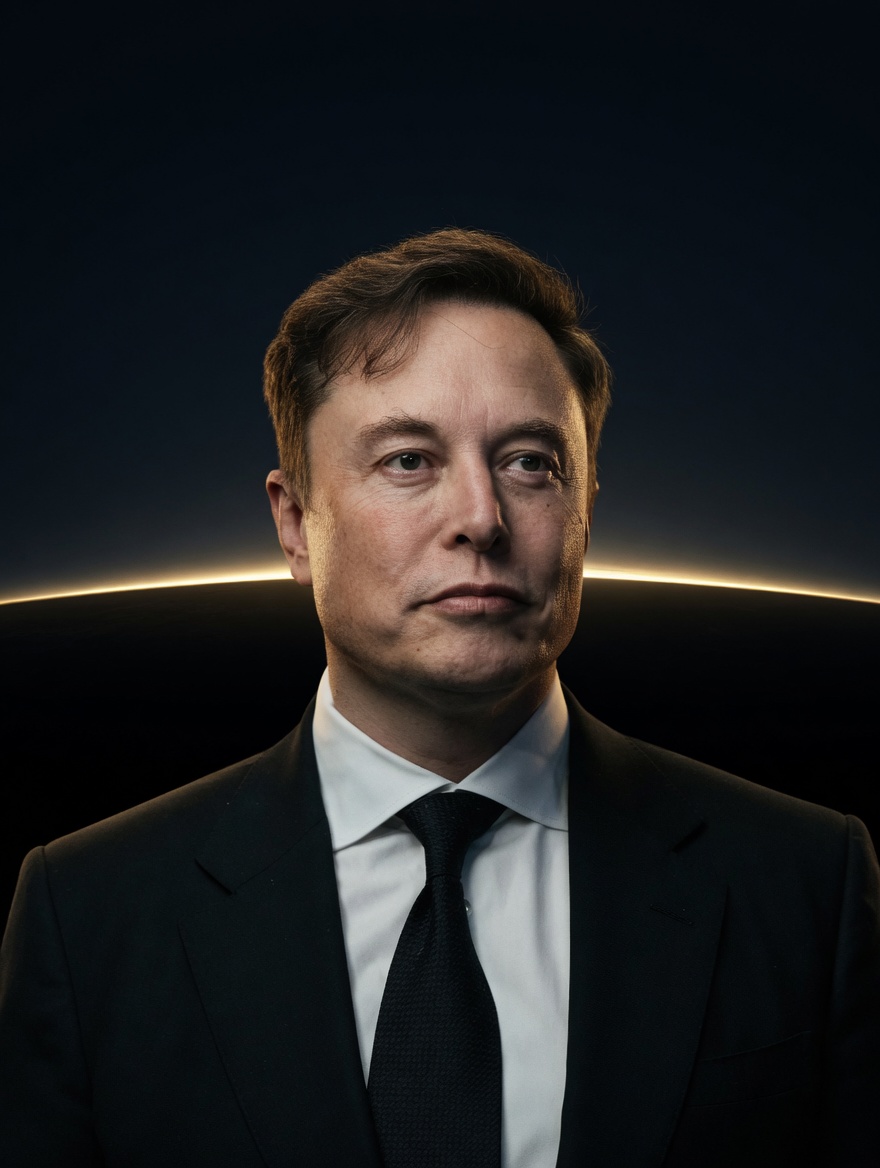
Elon Musk
Elon Reeve Musk was born 28 June 1971 in Pretoria. The arc people tell about him is not a mystery. A bullied kid who taught himself to code, left apartheid South Africa on his mother's Canadian papers, made enough money on the early internet to buy a ticket into industries that were supposed to be closed, then spent two decades trying not to go bankrupt while rockets and cars started working.
The first hero in the story is not him. It is Maye Musk — model, dietitian, single parent. He is named for her American grandfather, John Elon Haldeman. Read her page first if you want the origin, not the press kit.
The low end of the arc
After his parents divorced in 1979 he chose to live with his father, mostly because the house had an Encyclopædia Britannica and a computer. He has said he regretted it. At twelve he sold a BASIC game, Blastar, to a magazine for about $500. At Pretoria Boys High he was a decent, not glittering, student. He used Maye's Canadian citizenship to leave in 1989, skipped conscription, worked a farm and a lumber mill in Saskatchewan, then Queen's University and the University of Pennsylvania (physics and Wharton economics; the degrees were conferred in 1997).
He was accepted to a Stanford materials-science program in 1995 and did not enroll. The internet was faster.
Zip2, X.com, PayPal
With his brother Kimbal and Greg Kouri he co-founded Zip2, a city-guide stack for newspapers. Compaq bought it in 1999 for $307 million; his share was about $22 million. He put that into X.com, an online bank, which merged with Peter Thiel and Max Levchin's Confinity. The popular product was PayPal. The board ousted him as CEO in 2000. eBay bought PayPal in 2002 for $1.5 billion in stock; as the largest shareholder he took roughly $176 million.
That is the war chest. Everything after it is a bet that the money should go into things that are hard.
SpaceX
He founded Space Exploration Technologies in May 2002, CEO and chief engineer, with about $100 million of the PayPal money. The first three Falcon 1 flights failed. The fourth, on 28 September 2008, reached orbit — the first privately funded liquid-fueled rocket to do so. NASA had already given the company a COTS contract; a $1.6 billion cargo award followed that year and kept the lights on.
What SpaceX then did, in order:
| Year | What happened |
|---|---|
| 2010 | First Falcon 9 flight |
| 2012 | Dragon became the first commercial spacecraft to berth with the ISS |
| 2015 | First orbital-class booster landing, on land |
| 2018 | Falcon Heavy first flight; his Tesla Roadster as the dummy payload |
| 2019 | First large Starlink deployment; Starship development in public |
| 2020 | Demo-2 — first private company to put NASA astronauts in orbit and dock them to the ISS |
| 2024 | NASA awarded SpaceX the ISS deorbit vehicle contract |
By early 2026 Falcon 9 had flown more than 600 times, including 165 launches in 2025. Starlink, begun in 2015, was the majority of operational Earth satellites by 2025. The stated point of the company is still a self-sustaining city on Mars. Treat that as the thesis. The reusable booster is the proof of work.
He did not do it alone. Gwynne Shotwell, Tom Mueller, and the rest sold the flights and built the engines.
The other companies
Tesla was incorporated in 2003 by Martin Eberhard and Marc Tarpenning. Musk led the 2004 Series A, became chairman, then CEO and product architect in 2008 after a brutal year that almost killed both Tesla and SpaceX at the same time. A 2009 settlement lists him as a co-founder. The Roadster, Model S, Model 3, Model Y, Cybertruck, and the Gigafactories are the public artifacts. Tesla Energy swallowed SolarCity, the company his cousins Lyndon and Peter Rive built from an idea he seeded.
Neuralink (2016) is a brain-computer interface lab. The Boring Company (2017) digs tunnels. He co-founded OpenAI in 2015 and later left; xAI (now SpaceXAI) is the second try, and Grok is its product. In 2022 he bought Twitter for $44 billion and renamed it X in 2023. The pre-Musk story of that network is on Before X.
What to do with the myth
The useful version of the arc is mechanical. Leave a bad house. Write software at night. Get paid once. Spend the money on a problem that can kill you. Fail in public three times. Do not stop. Hire people who can sell and people who can machine a pintle injector. Land the booster.
The unhelpful version is destiny. He is also a polarizing public official-adjacent figure — the largest donor to the 2024 U.S. presidential election, briefly the de facto head of DOGE in 2025, then in a public fight with Donald Trump. This site is about Grok and the stack around it. The politics are real; they are not the rockets.
For the person who made the first half of the arc survivable, go to Maye.